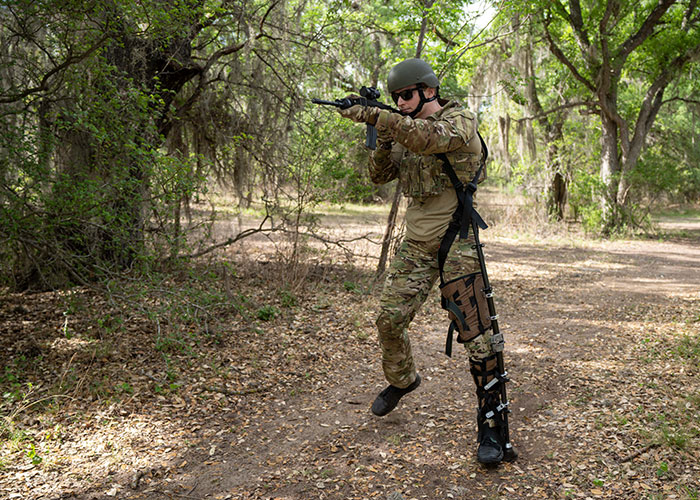

The U.S. Army has unveiled a revolutionary system designed to assist wounded soldiers in evacuating themselves from the battlefield. It is a response to lessons learned from recent conflicts, which have shown that medical evacuation is becoming increasingly difficult due to the threat posed by drones and artillery.Intrepid Battlefield EXoskeleton (IBEX) is a lightweight exoskeleton designed to enable wounded soldiers to evacuate themselves from the battlefield. Rather than enhancing the user's strength, IBEX allows them to leave the danger zone without assistance from others.
Developed through a collaboration between the U.S. Army Medical Research and Development Command and researchers from the Brooke Army Medical Center, the system allows injured personnel to move despite a fractured tibia, torn knee ligaments, severe ankle sprains, foot fractures, and similar injuries. IBEX is built around a telescopic lateral load-bearing frame connected to a hip harness and a stabilization system for the thigh, knee, and lower leg. Its key feature is the complete isolation of the injured limb from the load carried by the structure, allowing the exoskeleton to bear the user's body weight while significantly reducing stress on soft tissues, blood vessels, and nerves. In practice, this reduces pain and minimizes the risk of worsening the injury while moving.
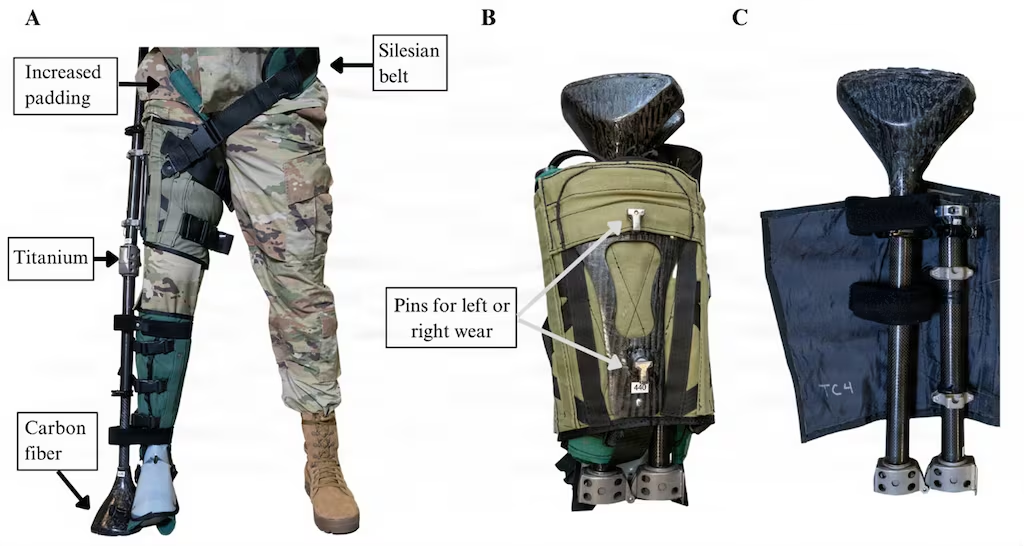
IBEX was designed as a lightweight, foldable system weighing approximately 3.2 kg that can be quickly fitted under combat conditions. Interestingly, the U.S. Army states that, when folded, IBEX is roughly the size of a 1-liter water bottle. This makes it significantly more portable than traditional stretchers, which require between two and four soldiers to carry and operate, along with additional security during evacuation. As a result, more troops can remain engaged on the battlefield, while the number of personnel exposed to enemy fire during casualty evacuation is greatly reduced.
The designers also addressed one of the greatest logistical challenges on the battlefield: difficult terrain. According to information released by the Army, the system successfully passed an airdrop test from a transport drone at an altitude of approximately 120 meters, making it possible to deliver the device directly to a wounded soldier even when rescue personnel cannot reach the location. The design incorporates a lower-leg orthosis module and a boot with a rocker sole, allowing the user to walk, assume a prone position, and return to a firing stance.
The project stands out for its unique approach to military exoskeletons. Unlike earlier programs such as HULC or TALOS, which aimed to increase soldiers' strength and endurance, IBEX focuses on enabling wounded personnel to leave the battlefield without assistance. This highly practical approach strongly suggests that the system has the potential to see real-world use in future military operations.